
Baggage & Sports Equipment | 11 minute read
Flying With a Surfboard: What to Check Before Choosing an Airline
Check surfboard acceptance before comparing fares. The packed length, operating airline and airport transfer can matter more than the advertised equipment fee.
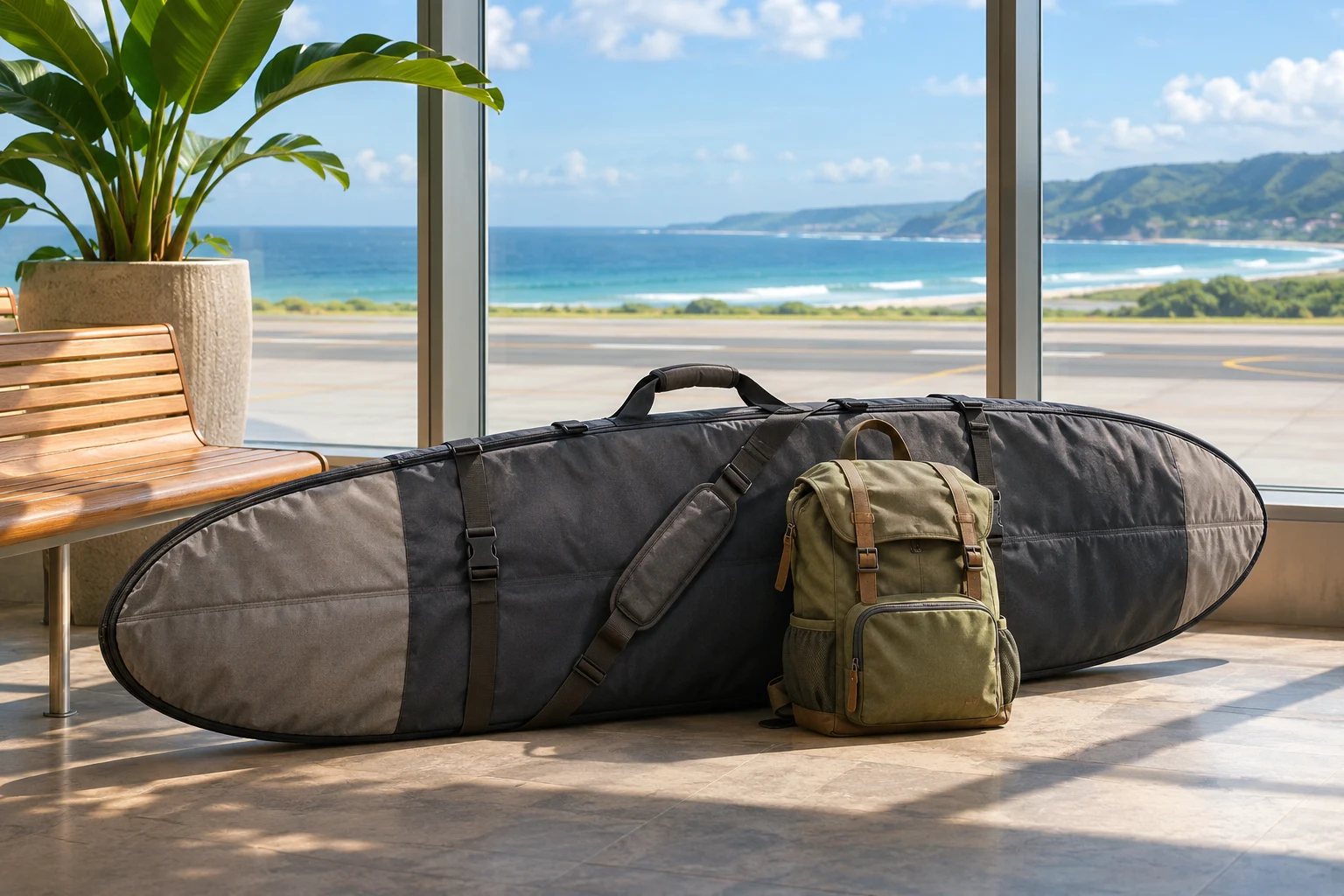
What should you check before flying with a surfboard?
Start with the dimensions and weight of your packed surfboard, then confirm that every operating airline accepts it on the route. Only compare prices once the equipment is suitable for carriage.
Length deserves particular attention. A board can be light enough for an allowance and still be too long for the airline's rules or the aircraft involved.
Include the transfer from the airport to your accommodation. A flight that accepts the board is only part of a useful travel plan.
For a short or flexible surf trip, compare renting locally. Bringing a familiar board can be worthwhile, but the decision should reflect the waves you expect, the days you plan to surf and the complete transport cost.
Measure the packed board, not just the board itself
Record the external length, width and depth of the finished bag, plus its total weight. Padding and the bag's shape can make the packed item larger than the board's nominal dimensions.
If carrying more than one board, check the permitted number and how the airline defines a sports item. A single bag does not automatically mean any contents are accepted under one purchase.
Include only permitted accessories when weighing the arrangement. Check whether fins, wetsuits or other belongings can travel in the board bag rather than treating spare space as a free suitcase.
Keep measurements in the units used by the carrier and double-check conversions. A small calculation error is easier to fix at home than at an oversized-baggage desk.
Use those exact details in inquiries. A description such as a standard surfboard leaves the airline or transfer provider to guess at the most important information.
Read the acceptance limit before the fee
British Airways' surfboard policy specifies a protective bag, length up to 240cm, width up to 75cm and weight under 23kg. It excludes routes through London City. Check the checked-baggage entitlement attached to your fare as well.
easyJet lists surfboards in its large sports-equipment category, with a 32kg maximum. Its sports-equipment guidance also separates sports weight from ordinary hold luggage, so unused suitcase capacity does not automatically increase the board allowance.
A different weight limit does not establish that one airline accepts every board the other declines. Read dimensions, packing instructions and route conditions together.
If the policy does not clearly cover your item, contact the airline before purchasing a restrictive ticket. Explain the packed size, board count and flight numbers.
Keep a record of the response and any required reservation. A paid sports fee should match an accepted item, rather than being used as a hopeful substitute for checking the rules.
Check every flight, including short connections
A long-haul service may connect to a smaller regional flight. Confirm the equipment can travel on that onward leg instead of assuming the main flight determines the entire journey.
Identify the operating airline for each segment. The company selling the ticket and the company flying the aircraft may be different.
Give the complete itinerary when asking about acceptance. Include any separate tickets and explain whether you intend to collect and recheck the board.
If a stopover or airport change is involved, plan where the board will go during that interval. Temporary storage and ground transport need their own checks.
Our guide to understanding codeshare operators helps identify whose flight-specific information you need.
A practical surfboard flight worksheet
| Question | Useful evidence |
|---|---|
| Will the board be accepted? | Current policy or confirmation for the packed item |
| Does every flight work? | Operating airlines and equipment reservations |
| What is the complete price? | Fare, board carriage and other bags |
| Can the transfer carry it? | Provider confirmation using dimensions |
| What happens at the destination? | Storage and transport to surf locations |
| Would rental be easier? | Suitable board availability and full rental quote |
Use the worksheet to eliminate unsuitable routes first. Comparing a low fare that cannot accommodate your board wastes time and can create an expensive change later.
Choose protection that meets the rules
Follow the airline's packaging instructions and the board bag manufacturer's guidance. Pay attention to how the nose, tail and rails are protected within the accepted arrangement.
Check whether components need removing and how they should be packed. If you are unsure about a fitting, ask a knowledgeable surf shop rather than forcing it to save space.
Inspect the bag's closures, handles and straps. Secure loose parts in the way the bag manufacturer recommends, keeping the finished item manageable for handling.
Do a trial pack before booking a new bag solely on its advertised size. The equipment needs to fit comfortably inside while the external dimensions remain acceptable.
Photograph the board and packed bag for your records. Keep identifying details and relevant documentation separate from the equipment.
Avoid adding clothing as padding without checking whether the airline permits it inside the sports bag. A clever packing idea can still conflict with the selected baggage category.
Add the board to the fare calculation correctly
Check whether the quoted sports price applies per flight, per direction or to the complete booking. Read the wording before multiplying or assuming the return is included.
Add ordinary checked luggage and any cabin purchase you genuinely need. A board allowance may leave your clothing bag entirely unpriced.
If the board uses an included checked item, consider what happens to the suitcase you would otherwise have used. You may need another item even though the board itself has no separate sports surcharge.
Compare equivalent itineraries for the same passengers and dates. A slightly different departure time can change transport and accommodation costs as well as the airfare.
Our guide to calculating the full flight cost helps organize the additions without mistaking a starting fare for the final bill.
Confirm the airport pickup can carry the board
Give the transfer provider the packed dimensions, board count and number of passengers. Include other luggage so the provider can assess the complete load.
Ask how the equipment will be carried and whether a larger vehicle or special arrangement is required. Do not rely on a vehicle photo that shows no luggage.
If renting a car, establish whether the board can be transported using an arrangement the rental company permits. Check the terms for any equipment you would add to the vehicle.
For public transport, consult the actual operator's rules for oversized items. A service that accepts ordinary suitcases may have different conditions for a long board bag.
Think through the final distance to the accommodation. A short walk on a map can be less convenient when carrying a board, a suitcase and a cabin bag.
Plan board storage and local travel
Ask the accommodation whether it has suitable space for the board and its bag. Describe the size rather than assuming a standard room will work comfortably.
If you plan to visit several surf spots, compare the transport needed to reach them with equipment. Renting a board at one beach and bringing your own everywhere are different travel patterns.
Consider a trip that starts and finishes in different places. You will need the protective bag at the departure point, even if you prefer traveling lightly between stops.
Check whether a surf camp or local provider offers equipment arrangements that match your plans. Ask for actual availability rather than relying on a broad description of facilities.
If your itinerary is still flexible, resolve these practical details before locking in flights. The most convenient gateway may become clear once you understand how the board moves through the whole trip.
Compare your own board with a suitable rental
Ask about the board types, sizes and rental period available at the destination. Compare an option you would be comfortable using, rather than the lowest advertised daily rate.
For a brief visit with uncertain surf plans, renting can remove airline charges and bulky transfers. It can also give you flexibility to choose equipment for the conditions you find.
For a longer trip or a specific board preference, bringing your own may justify the extra expense. Decide how much familiarity matters to the experience you want.
Check collection location, opening hours and return requirements. A rental arrangement that consumes much of the first morning may not suit a short stay.
Read the rental terms and clarify responsibility for equipment condition. Compare the complete arrangement, including any required deposit, without treating a refundable deposit as a certain trip cost.
An invented comparison for a surf trip
Suppose Flight A costs £180 return, board carriage adds £100 and a clothing bag adds £40. Suitable return transfers cost £90. The complete total is £410.
Flight B costs £250 with the accepted board covered by the selected checked allowance. Another bag costs £45 and transfers cost £70. That total is £365.
These are invented figures, not live offers. Flight B saves £45 under the stated assumptions, but only if its equipment acceptance and schedule meet your requirements.
Now suppose leaving the board at home lets you use Flight A without its £100 sports addition and reduces transfers by £30. The transport saving is £130. Compare that with a suitable rental quote for the planned surfing days.
If rental costs £110, the cash saving is £20. Whether that is worthwhile also depends on the board available and the convenience of collecting it.
Reserve the equipment and keep the evidence
Complete any required sports request or purchase for both directions. Check that the confirmation describes the correct traveler and flights.
If booking through a third party, establish how the equipment arrangement is made and who confirms it. Do not assume a generic baggage selection includes a surfboard.
Save the policy, booking receipt and relevant correspondence somewhere accessible during travel. This makes it easier to explain the arrangement if a question arises.
Recheck after a schedule or operator change. If the replacement flight cannot accommodate the board, contact the airline or seller before accepting a plan that no longer works.
Our guide to reviewing a booking before departure helps bring the flight and equipment details together.
Allow for the oversized-baggage process
Read the airline's airport instructions and arrival requirements. Plan time for check-in and any separate equipment handover point.
Check the destination on the baggage tag before the board leaves your possession. Keep the baggage receipt until the journey and any reporting process are complete.
At arrival, find the appropriate collection area and inspect the equipment promptly. Follow the airline's procedure if the board is delayed or appears damaged.
Before departure home, clean and dry equipment appropriately and check any relevant border requirements. Leave enough time to repack the board without rushing the protective arrangement.
Choose a route that fits a changing surf plan
If you expect to move between coastal towns, plan how the board and its travel bag will move with you. A convenient airport transfer does not solve every later journey.
Compare a fixed base with a traveling itinerary before buying a restrictive flight. Staying in one place can simplify storage, while moving may require more suitable vehicles and accommodation checks.
If your return airport differs from your arrival airport, verify the board arrangement for that direction independently. The transport provider and airline may both be different.
Consider whether a rental arrangement lets you change boards or locations in the way you intend. Ask the provider directly rather than assuming flexibility from a general advertisement.
For a weather-dependent trip, avoid valuing every planned surf day as certain. Compare the transport cost with the experience you realistically expect, including days when you might do something else.
Keep the equipment plan simple enough to adjust if the itinerary changes. A board that requires several tightly coordinated handovers can make a spontaneous detour more expensive.
Those practical limits are worth considering before the cheapest flight becomes the fixed point around which you have to rebuild the rest of the holiday.
If storage is limited, ask about the board bag separately from the board. A padded travel container can take more room than everyday equipment storage, especially when several travelers bring boards.
Your questions answered
Is a surfboard accepted if it is below the weight limit?
Weight is only one condition. Check the packed dimensions, equipment definition, packaging and any restrictions applying to the route or aircraft.
Can two boards travel in one bag?
Only if the chosen airline permits that arrangement. Check board count and item rules as well as the combined packed weight and dimensions.
Does a sports fee cover my clothing bag too?
Do not assume it does. Price ordinary luggage separately unless the booking explicitly includes the required arrangement.
Should I choose a nonstop flight with a board?
It can simplify handling, but compare the complete price and schedule. For a connection, confirm acceptance and baggage procedures on every leg.
Is rental a sensible alternative for a short trip?
Often it is worth comparing. Check suitable board availability and collection arrangements against the airline and transfer costs you would avoid.