
Airports & Destinations | 13 minute read
How to Fly to Machu Picchu From the UK: Choosing Your Arrival Airport
Build a UK-to-Machu Picchu itinerary through Lima and Cusco, allowing time for altitude, rail connections and the correct admission ticket.
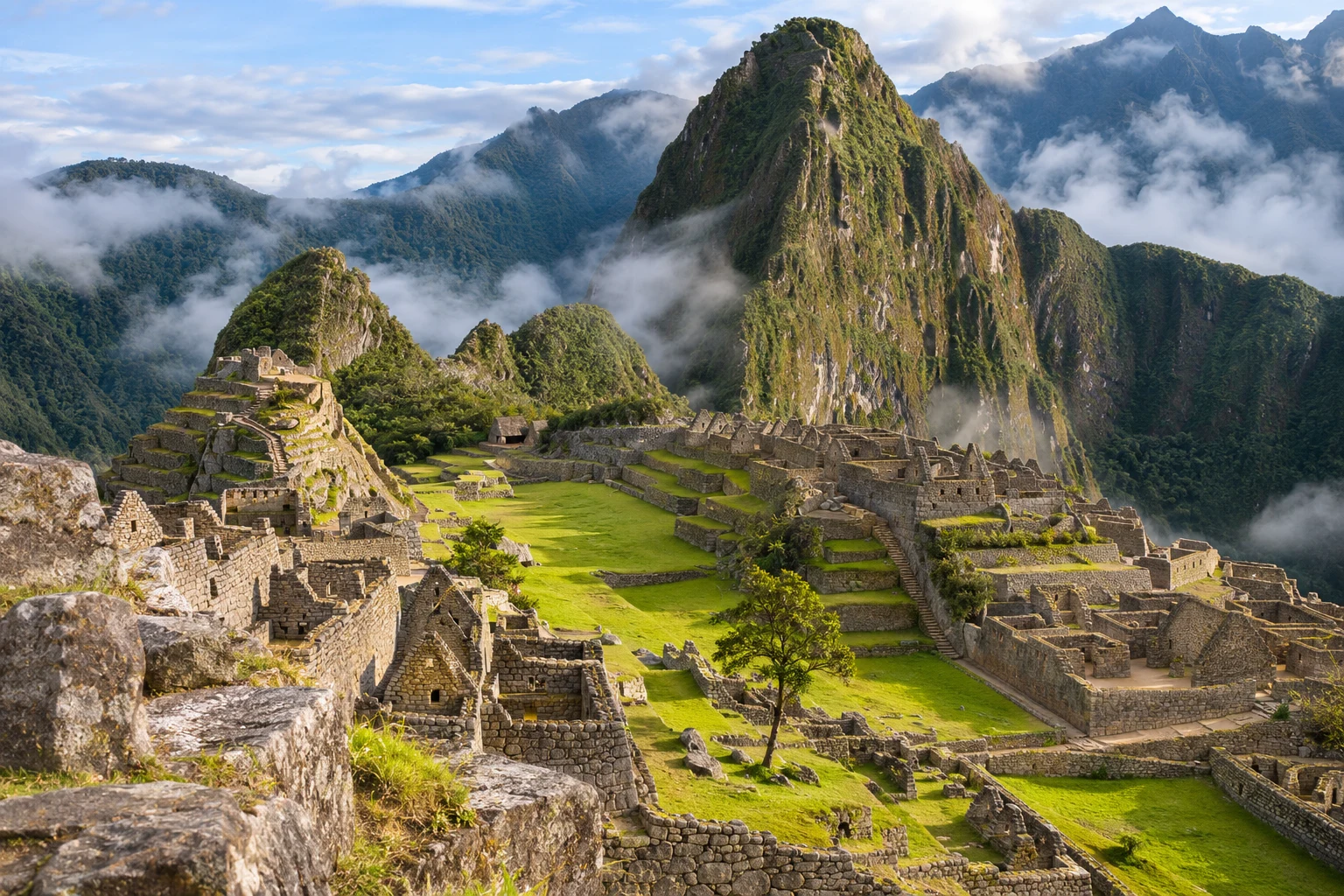
How to fly to Machu Picchu from the UK
You cannot fly to the ruins of Machu Picchu. For most UK itineraries, compare flights to Lima (LIM), an onward flight to Cusco (CUZ) and the ground journey through the Sacred Valley to the railway. From Machu Picchu Pueblo, also called Aguas Calientes, you continue to the archaeological site by the available local transport or walking route.
The best arrival airport decision is therefore part of a longer plan. Your flight needs to fit the altitude adjustment you may need, the train timetable and your dated admission ticket. Buying the cheapest flight first can leave the most important part of the trip difficult to arrange.
Start with the visit date and available official admission options. Then build enough time around the journey to reach the right entrance at the right time without depending on every connection running precisely to schedule.
The journey has several separate stages
| Stage | Usual planning choice | Check before booking |
|---|---|---|
| UK to Peru | International arrival in Lima | Connections, arrival date and baggage handling |
| Lima to the Andes | A flight to Cusco | Ticket protection, flight timing and altitude considerations |
| Cusco or Sacred Valley to the railway | Road transfer to the chosen station | Actual station, seasonal arrangements and reporting time |
| Rail journey | Train to Machu Picchu Pueblo | Train baggage rules and return availability |
| Town to the site | Local bus or suitable walking plan | Admission time, circuit and physical demands |
These stages can be packaged by an operator or booked separately. In either case, ask what is included and who is responsible if one stage changes. A tour description that mentions flights may still exclude some tickets or transfers.
Why Lima belongs in the first flight search
Lima is the main international gateway to investigate for this itinerary. Search the complete journey from your preferred UK airport, including any overseas connection. Check the operating airline and airport for every sector.
A connecting itinerary can be sensible when it offers a useful schedule or price. Compare the total elapsed time, baggage conditions and connection protection. A low fare that includes a long overnight wait may need a hotel or leave you tired before the next stage.
Check the arrival date carefully. An overnight flight can land the following day, and a subsequent domestic departure must be booked for the correct local date. Keep a written timeline rather than relying on a sequence of screenshots.
If Lima is part of the holiday, allow time to enjoy it. If it is only a connection, investigate the exact transfer process. Immigration, customs, baggage collection and rechecking may take time even when the flights appear together in a search result.
For separate international and domestic tickets, consider a planned buffer rather than the shortest possible connection. The saving should be weighed against the cost of replacing the Cusco flight and changing later reservations.
Cusco is the flight gateway, not the entrance
Cusco Airport brings you into the region, but the ruins remain a substantial onward journey away. Avoid descriptions that imply you can land and step straight onto a shuttle to the site entrance.
Decide whether you will stay in Cusco, continue to accommodation in the Sacred Valley or join an organized itinerary. Each choice changes the transfer you need after landing. Confirm the destination address rather than booking a generic airport pickup.
The location of your first hotel also affects the next day's travel. A property described as being in the Sacred Valley may still be some distance from the railway station you intend to use. Ask for the actual station transfer time and cost.
Keep the arrival day manageable. A flight, a long road transfer and a fixed train departure create several points where a delay can spread through the itinerary. Leave space to recover from the international journey and review any health considerations.
Compare flights in both directions. A convenient arrival in Cusco can be paired with a return departure that is too early to reach from your final hotel. The entire route should work before you commit to the fare.
Allow for altitude without making promises
Cusco is at high altitude, and altitude illness can affect visitors. The UK government's Peru health guidance highlights the risk. Seek advice from a travel health professional before departure, especially if you have a relevant medical condition or concerns about the itinerary.
Do not treat a fixed number of nights as a guarantee that everyone will adjust. People respond differently, and the places you visit may be at different elevations. A sensible schedule should leave room to rest and change plans if needed.
The TravelHealthPro Peru advice provides country-specific health information, including altitude considerations. Use professional guidance to decide how your route, activity level and medical history affect the plan.
Booking an energetic excursion immediately after arrival leaves little flexibility. Avoid making the first day depend on strenuous activity or a nonrefundable experience that you would feel pressured to complete while unwell.
Check your travel insurance for the planned altitude, activities and any relevant exclusions. If you are joining a trek, tell the insurer which route and elevations are involved. A general statement that the policy covers Peru may not answer those questions.
Choose the station before buying the train
The rail journey is a separate booking decision. Peru's protected-area visitor information describes access through the railway connection to Machu Picchu Pueblo. Ollantaytambo is an important station to investigate when planning the route through the Sacred Valley.
Read the departure station on the actual train product. A service marketed from Cusco may include a road segment, use a particular station or change its arrangement by season. Do not book a hotel transfer based only on the city named in the headline.
Check the operator's reporting time and required identification. Add the road journey from your accommodation, a margin for delays and time to find the correct boarding point. Train departure time is not the time to arrive at the station entrance.
Compare the return train at the same time as the outbound. A late return can be useful for a relaxed visit, but it may require another hotel night before flying from Cusco. That can be a good arrangement when planned deliberately.
If using an organized transfer and train package, ask what happens if the road segment is delayed. Confirm whether assistance is provided and whether a replacement train depends on availability or extra payment.
Check train baggage separately from airline baggage
The bag accepted by your international airline may be too large for your train booking. Read the current conditions for the exact service, including weight, dimensions and any advance arrangements for larger luggage.
PeruRail's luggage guidance is one example of the operator information to check. Other operators and products can have different conditions. Avoid relying on an old allowance quoted in a travel forum.
Many travelers find it useful to take a smaller bag for the Machu Picchu portion and store larger luggage with accommodation. Confirm that storage is offered, how long it is available and when you can collect the bag afterward.
Keep your passport, admission details, medication and essential clothing with you. If storage and onward collection involve different hotels, arrange that explicitly. A suitcase left in Cusco is inconvenient if your itinerary continues elsewhere without returning there.
Also check restrictions at the archaeological site itself. Train baggage rules and site entry rules are separate. The fact that you can bring an item on the train does not establish that you can carry it through the entrance.
Book the correct Machu Picchu admission
Use the official Machu Picchu ticket information and its link to the government booking system. Check the available circuits, entry times and conditions for your intended date before building the rest of the itinerary around a visit.
Different tickets can provide different routes and access. Read the description carefully rather than assuming every ticket includes every viewpoint or optional mountain walk. Choose the experience that suits your interests, fitness and available time.
Enter traveler details exactly as required and carry the specified identification. Check amendment and cancellation rules before payment. Tickets with named entry details should not be treated as freely interchangeable between members of a group.
Allow time to reach the entrance from Machu Picchu Pueblo. The train station and the archaeological site are different places. A train scheduled to arrive shortly before the admission slot may leave too little time for the onward journey and queues.
If a seller bundles admission with transport, request the exact circuit and time in writing. A general promise of a Machu Picchu visit is less useful than a confirmed ticket that matches the route you want.
When an overnight stay helps
A night in Machu Picchu Pueblo can make an early admission easier to manage. It separates the rail journey from the morning approach to the site and gives you a clearer starting point for the visit.
That does not mean every traveler must stay there. A same-day arrangement can work when the train, onward transport, entry slot and return all fit. Compare the actual timetable rather than accepting a rushed day simply because it uses one fewer hotel.
For a longer itinerary, consider where an additional night creates the most useful breathing room. It might be Lima after the international arrival, Cusco or the Sacred Valley before the railway, or the mainland city before the flight home.
Include hotel check-in and luggage storage in the plan. Arriving before a room is ready may be manageable if the property can hold your bag. Returning after checkout may require a separate arrangement.
Our guide to arriving early for an important event applies to a fixed admission booking too. The value of a buffer depends on how difficult and expensive it would be to replace the experience.
Compare the whole itinerary in one budget
List international flights, domestic flights, baggage, airport transfers, station transfers, trains, local transport to the site and admission. Add accommodation created by the schedule and any guide or tour you intend to use.
Compare package and independent arrangements using the same inclusions. One quote may include the return train and admission while another shows only an attractive starting price. Ask what remains payable locally.
Consider an invented example. A cheaper flight saves £90 but arrives too late for the planned connection, creating £120 of hotel and transfer costs. That route is £30 more expensive before considering the effect on the visit date. The figures are illustrative, not current prices.
Use our explanation of the full cost of a flight to keep the comparison consistent. For this trip, the train and admission schedule can influence the budget more than a small airfare difference.
Keep a contingency for changes, but do not use it as permission to book an impractical connection. Some problems involve unavailable admission or sold-out transport, which extra money may not solve immediately.
Check the itinerary as a chain
Write every stage in local time, beginning with the UK departure and ending with the return home. Include the exact airport, station and accommodation for each transfer. Mark separately booked sections so you can see where responsibility changes.
Verify entry requirements for Peru and any transit country using official guidance for your nationality. Check passport details, travel health advice and insurance before departure. Revisit those sources close to travel because conditions can change.
Our flight booking checklist covers the final airfare checks. Add the Machu Picchu ticket circuit, entry slot and train station to your own version. Those details deserve the same attention as the spelling on the airline booking.
Know which reservation needs attention first
If a flight changes, review the admission slot before moving other bookings. The site ticket may have fewer suitable alternatives than a hotel or road transfer. Check its amendment rules and availability before assuming you can shift the visit by one day.
Contact the train provider next and explain the revised plan. Ask which departures remain available and whether the existing ticket can be changed. Keep any written confirmation of the new station, date and reporting time.
Then update accommodation and transfers. Tell the hotel if your arrival moves late into the evening, and confirm that the driver has the revised flight number. A changed airline booking does not automatically notify independently booked providers.
If an operator manages the whole itinerary, ask it to confirm the revised sequence in one document. Check that the admission, train and transfers still agree. A replacement flight alone does not establish that every later stage has been repaired.
Keep receipts and records of disruption if you intend to make an insurance or passenger-rights claim. Follow the relevant notification requirements and avoid assuming that every extra expense will be reimbursed.
Before accepting a revised itinerary, check the physical demands too. Recovering a lost day by compressing several transfers and activities can create a trip that no longer suits your needs. A less ambitious revised plan may be more useful than preserving every original stop.
Ask whether the hotel can hold your smaller travel bag after checkout until your return train departure time.
Your questions answered
Which airport is closest to the usual Machu Picchu travel route?
Cusco is the main flight gateway to investigate for the onward Sacred Valley and rail journey. It is not an airport at the ruins. You still need road transport, a train or another suitable access arrangement and the final journey from Machu Picchu Pueblo to the entrance.
Should I fly to Lima or Cusco from the UK?
Compare a complete itinerary through Lima to Cusco, while checking other offered connections carefully. Lima is the international gateway to investigate first, and Cusco serves the regional part of the trip. Decide whether you need a mainland stop and whether the flights are protected together.
Can I visit Machu Picchu on the day I land in Cusco?
Do not build the trip around a tight arrival-day visit. The onward road and rail stages take time, admission is tied to the booked conditions and altitude may affect how you feel. A less compressed schedule gives you more room for delays and personal needs.
Does the train ticket include entry to Machu Picchu?
Do not assume it does. Train travel, site admission, local transport and guiding can be separate purchases. If buying a package, request an itemized confirmation showing the exact admission circuit and time as well as the train services.
How many days should I allow before visiting?
There is no single number that suits every traveler or guarantees altitude adjustment. Consider the international journey, medical advice, your chosen route and the available train and admission times. Build enough flexibility to rest or change plans rather than relying on an unusually tight sequence.