
Baggage & Extras | 7 minute read
Personal Item vs Cabin Bag: What Is the Difference?
A personal item usually fits under the seat, while a larger cabin bag normally uses the overhead locker. Your fare decides whether you can bring one, both or a paid extra.
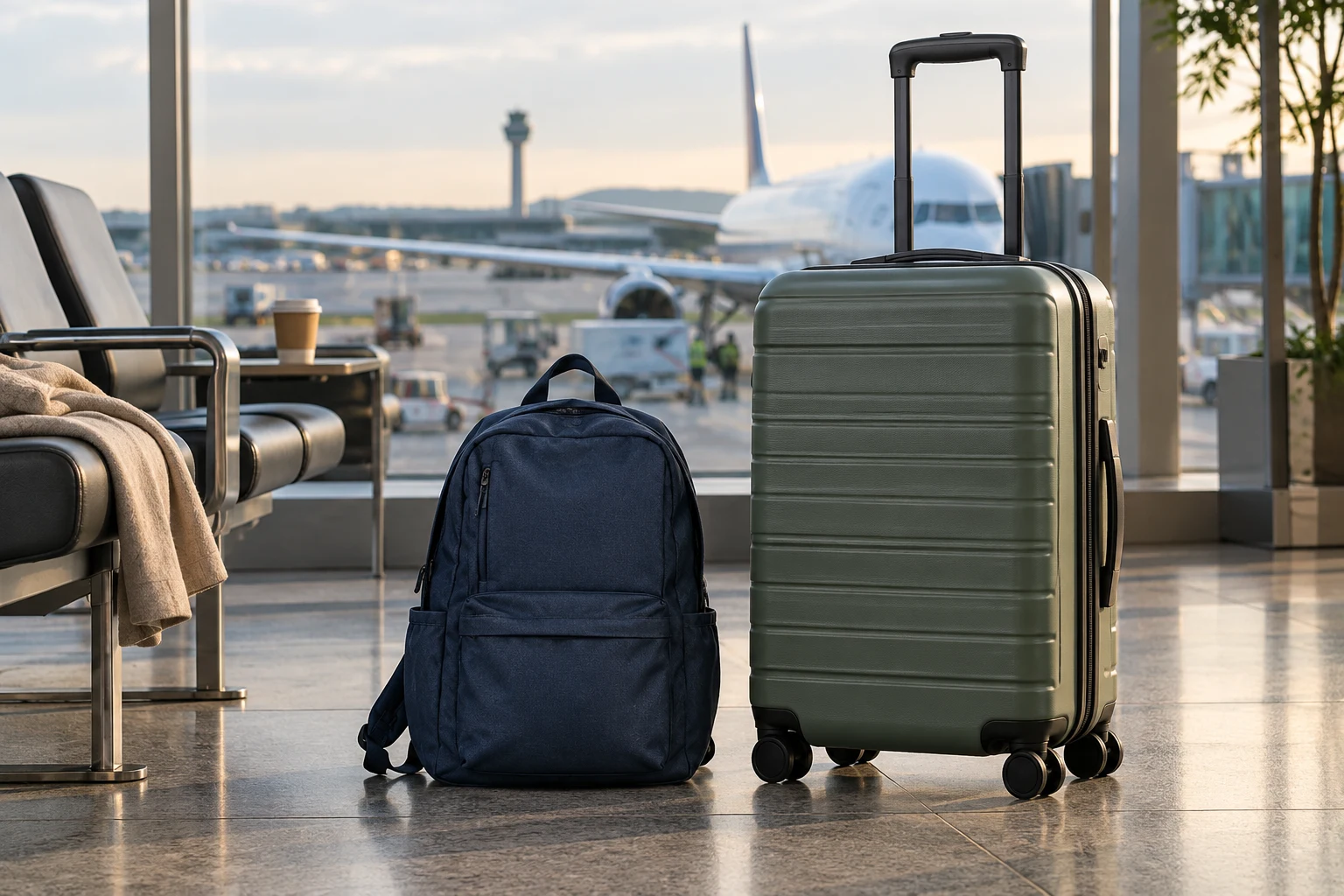
Personal item vs cabin bag: the practical difference
A personal item is the smaller bag normally stored under the seat in front of you. A cabin bag, often called a carry-on, usually means a larger bag stored overhead. Airline terminology varies, so check the dimensions and number of pieces included in your fare rather than relying on the label alone.
A backpack can fall into either category. A compact one may qualify as a personal item, while a large travel backpack may count as the overhead bag. Wheels do not automatically make a bag a carry-on, either.
What each type of bag is for
| Feature | Personal item | Larger cabin bag |
|---|---|---|
| Usual storage | Under the seat ahead | Overhead locker |
| Common examples | Small backpack or handbag | Wheeled case or larger backpack |
| Useful contents | Documents and items needed during travel | Clothing and other permitted belongings |
| Fare inclusion | Often included, but verify | May be included or sold separately |
Use the personal item for things you need to reach during the flight, while complying with storage instructions for takeoff and landing. Keeping a charger buried under a week's clothing in the overhead case makes a short task unnecessarily theatrical.
The larger bag can hold most of your packing, but plan for the possibility that it is checked at the gate. Keep essential documents and permitted medication in the item you retain.
There is no universal personal-item size
Each airline sets its own dimensions. Two bags sold as under-seat luggage may have different sizes, and a bag accepted by one carrier may exceed another's limit.
As checked on November 1, 2026, easyJet's small cabin bag limit is 45 x 36 x 20 cm, including handles and wheels. Its larger cabin bag category has a separate limit and requires the appropriate entitlement. That example should not be applied to another airline.
Check all three dimensions. Depth is easy to overlook because a soft bag expands when filled. Measure external pockets too, and avoid assuming that a compressible bag will be accepted if it cannot fit as required when packed.
Our guide to comparing cabin baggage allowances explains how size, weight and fare inclusions work together. A bag needs to satisfy every applicable condition, not just the one printed most prominently on its sales page.
Count everything you carry separately
A handbag, laptop sleeve and backpack may be treated as separate pieces. If your fare permits one personal item, you may need to consolidate them inside that item before boarding.
Check the policy for airport purchases and additional accessories. Do not assume a shopping bag is automatically exempt from the piece limit. Leave enough room to pack it inside your allowance if required.
Items such as mobility aids or infant equipment can have separate rules. Confirm those provisions directly instead of treating ordinary baggage advice as the answer to a specialist requirement.
If you remove items for security screening, put them back into the permitted bags afterward. The temporary arrangement of trays at the checkpoint does not establish how many pieces you can carry onto the aircraft.
Check the bag entitlement before choosing the fare
Look for explicit wording that distinguishes a small under-seat bag from a large overhead bag. A low fare may include the former and charge for the latter.
Do not confuse a checked-baggage product with a cabin-baggage product of the same weight. A bag sold as a checked item must normally be taken to the appropriate desk, even if its physical size resembles a carry-on.
Compare the cost of adding the bag with the next fare bundle. Include only benefits you would use and check whether the addition applies to each direction. A baggage price shown for one flight may not cover the whole return trip.
Save the confirmation after payment. If the booking summary still shows only the smaller item, resolve the discrepancy before travel rather than relying on your memory of the checkout screen.
Under-seat space affects your comfort too
A personal item occupies space near your feet. If the bag is packed tightly to the maximum size, it may leave less room to stretch. Consider that tradeoff on a longer flight.
Keep the bag fully within the permitted storage area and follow crew instructions. It should not obstruct the aisle or another passenger's space.
Some seat positions have different storage arrangements, especially bulkhead or exit-row locations. You may have to place all bags overhead during certain phases of the flight. Check the seat information before assuming your personal item will always remain at your feet.
Choose a bag you can carry comfortably through the terminal. A small bag packed with heavy electronics can be harder to manage than a larger rolling case, even though it qualifies for a cheaper allowance.
Prepare for an overhead bag to be checked
Cabin space can be limited, and an airline may ask you to hand over an overhead bag. Ask whether you will collect it at the aircraft or at baggage reclaim, particularly if you have a connection.
Remove anything that must stay in the cabin before handing it over. The FAA's lithium-battery rules require spare batteries and power banks to remain in carry-on baggage. Check the airline's own restrictions as well.
Keep a small accessible pouch for documents and essentials so you can transfer them without unpacking the whole case. The pouch still needs to fit within the baggage arrangement permitted for your flight.
If your bag is oversized or your fare lacks an overhead entitlement, a gate charge may apply. That situation is different from an airline checking a compliant bag for operational reasons.
Choose the smallest setup that meets the trip's needs
For a short visit, a personal item alone may be enough if your clothing and permitted toiletries fit comfortably. Try packing before buying the fare so that the decision reflects the bag you will actually carry.
For a longer trip, compare an overhead bag with a checked bag. Laundry access, climate and equipment needs matter more than a fixed rule about the number of nights.
Our comparison of cabin and checked luggage for different trips can help when the packing list exceeds a small bag. Choose a workable allowance rather than planning to argue about an overfilled backpack.
Check the category again when airlines change
On a journey with more than one operating airline, the same backpack can be classified differently under each allowance. Compare its packed measurements with every relevant segment before choosing a cabin-only plan.
If the second flight allows only a smaller personal item, adding an overhead bag on the first flight does not solve that mismatch. You need suitable entitlement for the flight where the bag exceeds the included category.
Keep the purchase confirmations together, labeled by flight and traveler. This makes it easier to show which bag was added if the booking website presents the two journeys separately.
After a rebooking, inspect the new operator's instructions. An aircraft change or replacement service can also affect storage arrangements even when your bag entitlement remains valid.
Check bags again after adding last-minute items. A jacket or water bottle can change the packed dimensions of an compliant backpack.
Your questions answered
Can a backpack be my personal item?
Yes, if it meets the airline's personal-item dimensions, weight rules and storage requirements. A large travel backpack may instead count as the overhead cabin bag.
Does a laptop bag count as an extra item?
It can. Check whether your allowance includes a separate laptop bag or whether it must fit inside your permitted personal item. The fact that it contains work equipment does not automatically exempt it.
Can I put my personal item in the overhead locker?
Follow the airline and crew's storage instructions. Space may be reserved for larger cabin bags, and certain seat positions require different arrangements. Your entitlement is based on the policy, not simply where the bag happens to fit.