
Baggage & Extras | 12 minute read
Hand Luggage Allowances: How to Compare Airlines Before You Book
Compare the bags included in the exact fare, then check their size, weight and storage rules. A low ticket price can change considerably when your suitcase needs its own upgrade.
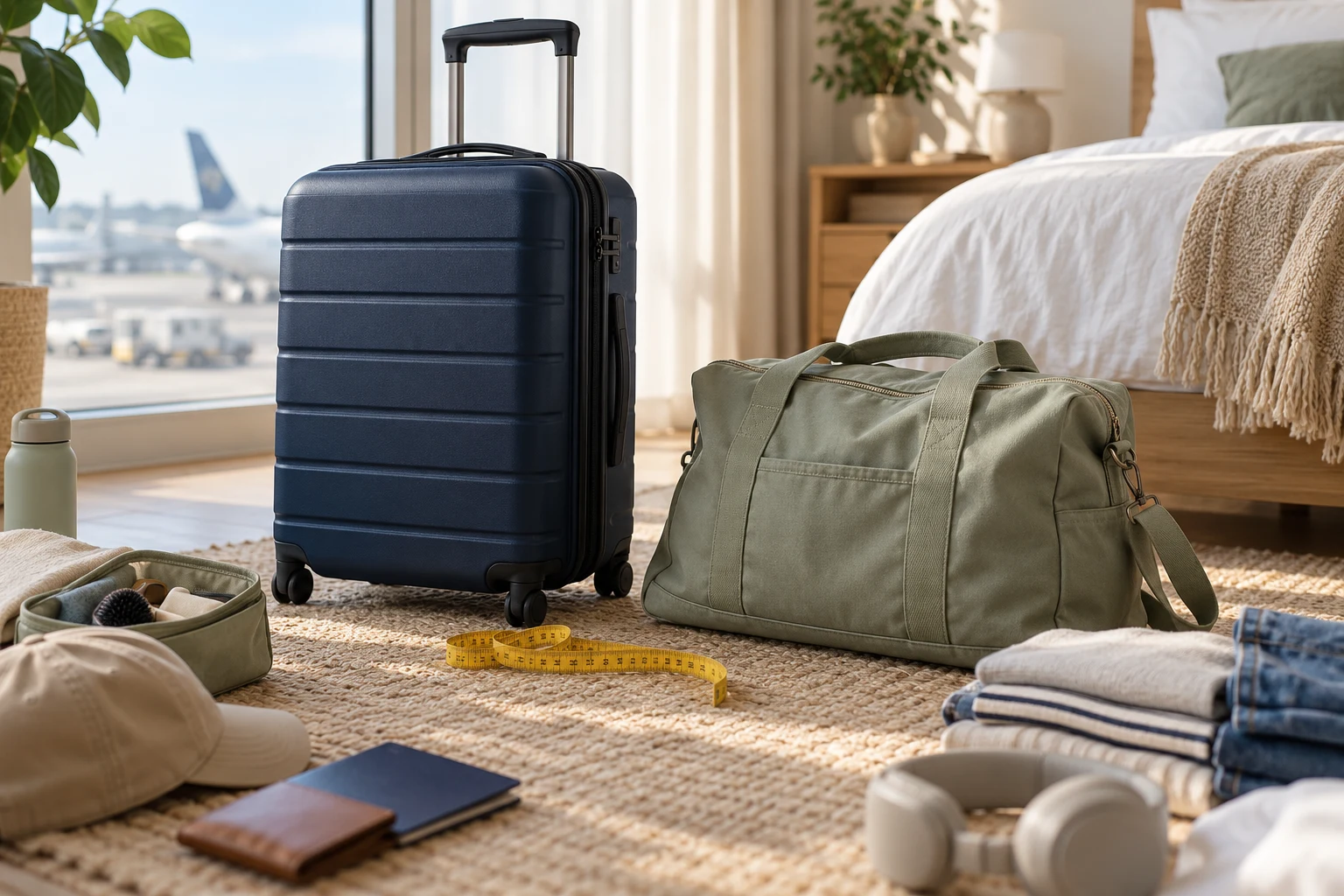
How to compare a hand luggage allowance
A hand luggage allowance describes what you may bring into the cabin, including the permitted number of bags, their dimensions and any weight limits. Compare the exact fare for every flight, since one ticket may include only a small under-seat bag while another includes an overhead cabin bag too.
Start with the bags you intend to take. Measure and weigh them packed, then match those requirements against the airline's current policy and the inclusions shown at checkout.
The label cabin approved on a suitcase is only a retailer's description. Airlines set their own conditions, and the label has no persuasive powers at a boarding gate.
Separate the personal item from the overhead bag
A personal item usually goes under the seat in front of you. Depending on the airline, it may be described as a small cabin bag, handbag, laptop bag or under-seat bag. Its dimensions still matter even when the item looks modest.
A larger cabin bag normally goes in an overhead locker. It may be included, available as a paid addition or bundled with another fare. Do not assume the phrase hand luggage means both items are included.
Our guide to under-seat bags and larger cabin cases explains the distinction. For comparison purposes, list the two entitlements separately so that a small bag is not mistaken for a wheeled suitcase allowance.
Also check whether a handbag or laptop sleeve counts as the personal item. Carrying it outside your backpack can turn one bag into two. You may need to put smaller items inside the permitted bag before boarding.
Some items have separate provisions, such as mobility equipment or infant supplies. Look up the relevant policy rather than assuming they either count toward the ordinary allowance or are automatically exempt.
Measure the packed bag in three dimensions
Use the airline's stated height, width and depth limits. Where wheels, handles and external pockets are included, measure the full outside dimensions. A suitcase manufacturer's main-body measurement can be smaller than the size presented at the airport.
Measure after packing. A soft bag that fits when empty can bulge beyond the depth limit once it contains shoes and a jacket. Expanding a suitcase zipper can also change an otherwise compliant bag into an oversized one.
Place the bag on a flat surface and measure its widest points. Include anything permanently attached. If you are close to a limit, leave room for minor measurement differences rather than relying on squeezing a rigid shell into a smaller space.
Keep units consistent. Convert carefully if a retailer gives inches and the airline gives centimeters. Rounding a dimension down because it is convenient does not change the size of the bag.
For an irregular backpack, check how it sits when fully packed. External bottles, dangling equipment and a thick front pocket can matter. The published limit applies to the item you bring, not the tidier version shown in the product photograph.
Read how the weight limit is applied
Airlines may set a limit for one bag, a combined cabin allowance or different rules for different pieces. Read the wording carefully before deciding how to distribute heavier items.
Weigh the packed bag with its usual contents, including chargers and accessories. If you plan to buy items during the trip, leave some capacity for the return. A bag that passes outbound can become too heavy after a week of shopping.
Check whether you must be able to lift the bag into the overhead locker yourself and what assistance arrangements apply if you cannot. A generous numerical allowance does not necessarily make a heavy case practical.
Do not rely on reports that an airline rarely weighs cabin bags. Enforcement can vary, but your booking still has an allowance. Comparing fares on the assumption that a limit will be ignored creates an avoidable airport expense.
If one flight has a lower allowance, plan for that segment too. You cannot carry a heavier bag through the whole journey simply because the first airline permits it.
Examples of why the details matter
The examples below were checked on November 1, 2026. They illustrate different allowance structures, not every exception or fare benefit. Recheck the linked airline information and your selected booking before purchase.
| Airline | Small item | Larger cabin bag | Check carefully |
|---|---|---|---|
| easyJet | 45 x 36 x 20 cm, up to 15 kg | 56 x 45 x 25 cm, up to 15 kg when entitled | Larger bag entitlement must be included or added |
| Ryanair | 40 x 30 x 20 cm | Priority & 2 Cabin Bags includes a 10 kg bag, 55 x 40 x 20 cm | A 10 kg checked bag is a different product |
| British Airways | 40 x 30 x 15 cm | 56 x 45 x 25 cm | Check the booking and partner-operated flights |
These dimensions make the comparison concrete. A bag sized for one airline's overhead allowance may exceed another's depth limit. A small item accepted under one seat allowance may be too large for a different airline's personal-item category.
Use the table as a prompt to open the official policy. Your fare, membership benefits or operating carrier can affect what is included, and future policy changes can make an old packing checklist inaccurate.
Check what your selected fare actually includes
Open the fare comparison before entering passenger details. Look for separate lines for personal items, cabin baggage and checked baggage. If the display uses icons, open their explanation rather than interpreting a suitcase symbol by appearance.
Then inspect the final checkout summary. An allowance shown for a more expensive fare column may not apply to the cheaper fare you selected. Confirm the baggage attached to your actual reservation.
Be careful with bundles. Priority boarding, seat selection and a larger bag may be packaged together, but those benefits are not interchangeable. A seat near the front does not inherently create extra baggage entitlement.
If the bag you need is sold separately, compare its price with the upgrade to the next fare. Count only the other benefits you would use. An unused seat choice should not be assigned an imaginary value to justify the bundle.
For a return booking, check whether the addition applies to both directions or only the selected flight. Also confirm which traveler it belongs to if several people share the reservation.
Build a simple fare worksheet
Write down the same packing requirement for each option, such as one small backpack plus one overhead case per traveler. Then compare the final totals after adding whatever each fare lacks.
| Item | Fare A | Fare B |
|---|---|---|
| Base ticket | $80 | $110 |
| Required overhead bag | $35 extra | Included |
| Comparable total | $115 | $110 |
These are invented prices, not current airline offers. The example shows why the lowest base fare can lose its advantage once the baggage setup is equivalent.
For a group, decide how many larger bags you actually need. Buying one for every traveler may be unnecessary, but each person still needs to comply with the allowance assigned to them. Confirm any shared arrangement with the airline.
If the larger bag is essential, check availability before treating the quoted addition as guaranteed. Some cabin products are capacity-limited. A plan that depends on adding one later should account for the possibility that it is unavailable.
Check every operating airline in the journey
Look at the operating carrier for each segment, especially on codeshares. The company selling the ticket may not be the airline providing the aircraft, and cabin baggage instructions can differ.
Save the rules for the most restrictive relevant segment and pack accordingly, or arrange a different baggage solution before travel. Do not assume staff at the first airport can waive another carrier's requirements.
If a cabin bag must be checked during a connection, the transfer process can change. You may need a bag-drop desk or have to collect the bag later. Ask where it will be delivered and whether the onward connection remains practical.
With separate tickets, this issue is especially important. A cabin-only plan may have been chosen to avoid reclaim and recheck. A bag that exceeds the second airline's allowance can undo that plan at an inconvenient moment.
Separate airline allowance from security rules
A bag can meet the airline's dimensions and still contain something security will not allow through the checkpoint. Check the departure airport's current rules for liquids and other restricted items, including any airport where you will be screened again.
Do not assume every airport uses the same liquid procedure. Equipment and local rules can differ. Pack for the relevant checkpoints rather than relying on what happened on your last flight.
Battery-powered items need their own checks. The FAA's battery guidance says spare lithium batteries and power banks belong in cabin baggage and must be removed if the bag is checked. Check your airline's additional restrictions too.
Keep passports, necessary medication and other essentials in the small item that stays accessible. An overhead bag can sometimes be placed in the hold for operational reasons even when it meets the allowance.
If staff take a bag at the gate, confirm its collection point and remove items that must remain in the cabin. Do this before handing it over, while you can still reach the relevant pockets.
Make the last check before leaving home
Open the current booking
Confirm each flight's operating airline and the baggage product purchased for each traveler.
Measure and weigh the packed bags
Include wheels, handles and external pockets where the airline requires them.
Check the contents
Review security and dangerous-goods requirements for the complete route.
Save the evidence
Keep the allowance and any baggage receipt accessible offline.
If you discover a mismatch, compare available online additions while there is time to change the plan. Our guide to choosing when to buy baggage explains why waiting until the airport can be an expensive solution.
Recheck after a flight change or rebooking. A different operator or fare arrangement may bring different instructions, even if the destination has stayed the same.
Check a new suitcase against your usual airlines
If you are buying luggage, start with the airlines and fare types you expect to use. A case marketed for a broad region may still exceed the limit on a particular carrier or on its cheapest fare.
Compare the product's full external measurements with the airline's published limits. Look for whether the seller includes wheels and handles. If the listing only supplies a capacity in liters, ask for the dimensions before purchasing.
Consider the empty weight as well as the capacity. A heavy shell uses part of the allowance before you add clothing. That can matter on routes where cabin weight is tightly limited.
A smaller case can provide flexibility across several airlines, but check whether it holds what you need. Buying a bag that technically fits every allowance is less useful if you must then purchase checked baggage because your ordinary packing does not fit inside.
For soft bags, inspect the structure when packed. A flexible exterior can help with storage, but it does not create permission to exceed the published dimensions. Avoid treating compression as a substitute for measuring.
Check the return policy before removing tags or using the bag. Trying your usual packing at home can reveal whether the advertised size and weight suit your trips while you still have an opportunity to choose another model.
Your questions answered
Does hand luggage always include a suitcase and a backpack?
No. Some fares include only one small under-seat item. Check the number of pieces and whether an overhead bag is included or needs to be added separately.
Are wheels and handles included in cabin bag measurements?
Many airlines include them, and the examples above do where stated. Read the specific airline's measurement instructions and measure the complete packed item rather than relying only on the retailer's headline size.
Can a compliant cabin bag still go in the hold?
Yes, operational circumstances or limited cabin space can lead to gate checking. Follow staff instructions, remove items that must remain in the cabin and confirm where you will collect the bag.
Can I combine two travelers' cabin weight allowances?
Do not assume so. Cabin allowances can apply per person or per item, and pooling rules vary. Check the airline's exact policy before packing one bag above its stated limit.