
Baggage & Sports Equipment | 11 minute read
Emirates Baggage Allowance: Weight vs Piece Rules Explained
Emirates uses weight and piece allowances on different journeys. Learn how to read your ticket, compare fare options and pack without confusing a total allowance with a per-bag limit.
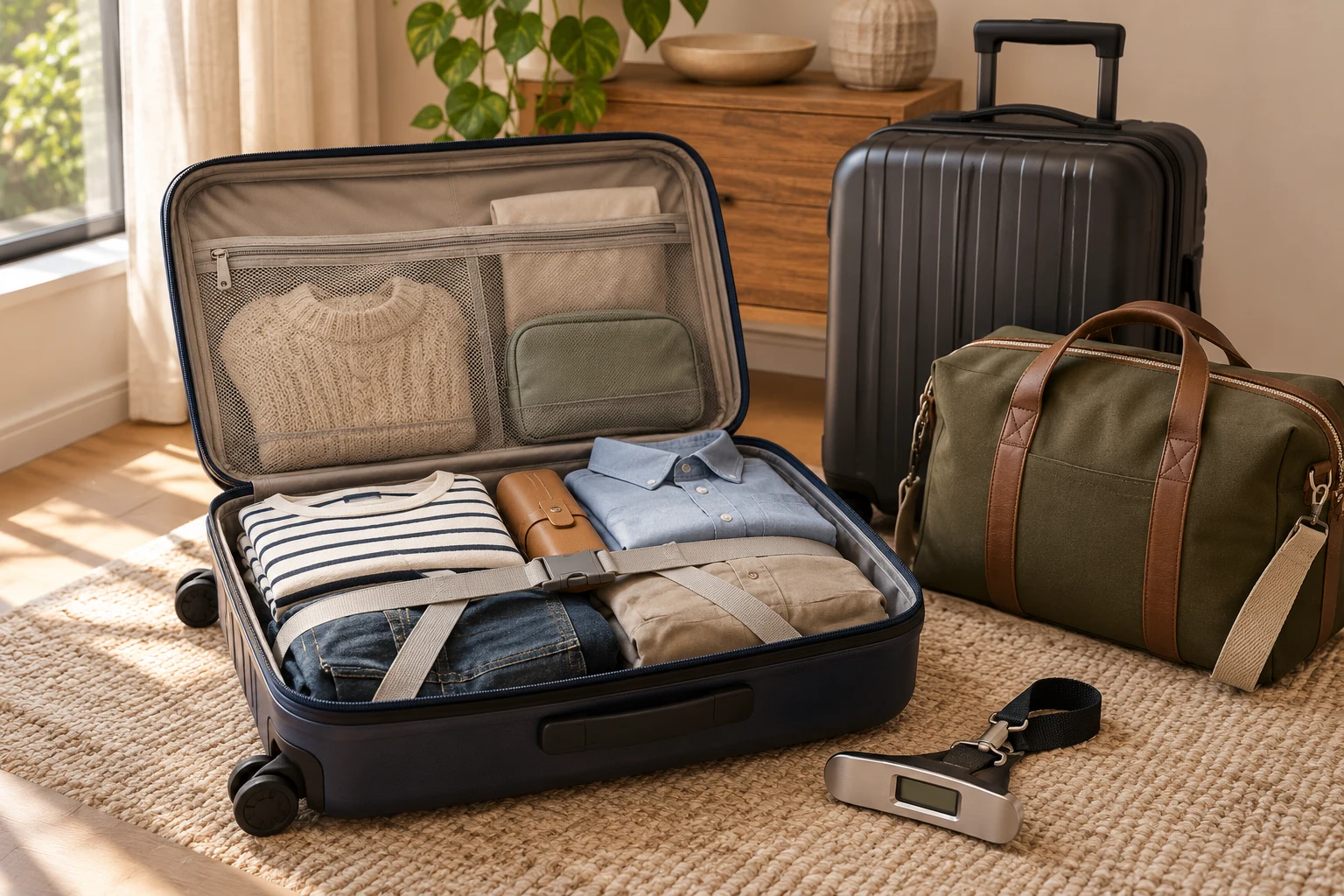
Emirates baggage allowance: weight or pieces?
Start by checking whether your Emirates booking gives a total checked weight or a number of checked bags. Those are different systems, and the distinction changes how you should pack and compare fares.
Your itinerary, cabin and fare determine the applicable allowance. Read the booking details before relying on a general table, especially for stopovers or partner-operated flights.
Keep checked baggage and cabin baggage separate. An allowance in the hold cannot simply be transferred to the overhead locker.
The useful question is whether your packed bags comply with your actual ticket. A large number on a fare comparison page is only the beginning.
The main published checked-baggage rules
Emirates' checked-baggage guide uses weight on most routes and pieces for Americas and Africa journeys, subject to itinerary exceptions.
| Economy fare | General weight allowance |
|---|---|
| Special | 20kg |
| Saver | 25kg |
| Flex | 30kg |
| Flex Plus | 35kg |
Saver has a 30kg exception for qualifying Europe-to-Australia or New Zealand journeys. Under the general piece rules, Special allows one 23kg bag and other economy fares two. Within the Americas and between the US and Europe, Saver also allows only one.
Individual bags must not exceed 32kg. Current combined dimensions are 203cm under weight rules and 150cm under piece rules, with oversize charges applying above the latter threshold up to the accepted maximum. Stopovers and partner flights can alter the applicable rules. Confirm your booking.
Use those facts to identify the right questions, then record the allowance attached to the ticket you intend to buy.
How a total-weight allowance works in practice
A weight allowance concerns the combined weight of your checked baggage. Add the weights of the bags you plan to check, while also respecting the limits that apply to each individual item.
For illustration, suppose your ticket permits 30kg total and you plan to check bags weighing 17kg and 11kg. Their combined weight is 28kg. That calculation addresses weight, but you must still check dimensions and any other applicable conditions.
Now suppose the same bags weigh 19kg and 13kg. Their combined weight is 32kg, so the packing plan exceeds the illustrative allowance even though neither bag looks especially large.
Write the total down rather than estimating by lifting the suitcases. Handles are good at making optimism feel like measurement.
A lighter empty suitcase can help, but compare its dimensions and practicality too. Replacing a bag makes sense only if the expense and inconvenience are justified by your needs.
How a piece allowance changes the calculation
A piece allowance limits the number of bags and the permitted weight of each. You need to satisfy both parts.
Suppose an illustrative booking allows two bags up to 23kg each. Two bags weighing 21kg and 22kg fit that weight pattern. One weighing 27kg and another weighing 16kg does not become compliant merely because the combined weight is the same.
The total is not the whole rule.
Check the bag count too. Three small bags can present a different issue from two larger ones even if their combined weight is lower.
When comparing fares, write the allowance as a full phrase. Two bags up to a stated weight each is more informative than reducing the entry to a theoretical combined maximum.
This also helps when comparing Emirates with another airline using a different system. Choose the allowance that suits your actual luggage rather than the one with the biggest-looking number.
Find the allowance for your itinerary
Open the booking confirmation or manage-booking record and locate the baggage details. Check the route, fare and passenger before copying the allowance into your travel notes.
Inspect both directions. Separate tickets, changed flights or different operators can require separate checks.
If the journey includes a stopover, do not assume the rule for a simple connecting itinerary applies unchanged. Use the itinerary-specific information and ask Emirates or the ticket seller to clarify anything inconsistent.
Keep the confirmation with any baggage-purchase receipt. If you later change the flight, check whether the purchase and allowance still apply as expected.
For a family, record each person's entitlement rather than relying only on a party total. Confirm any permitted sharing before packing one passenger's bag beyond its applicable limit.
Emirates cabin baggage is a separate allowance
The current Emirates cabin-baggage rules list a 7kg carry-on allowance in Economy and 10kg in Premium Economy, with dimensions up to 55 by 38 by 22cm. Business and First have different arrangements, and route exceptions apply, including Brazil and India provisions.
Check the rule for your cabin and departure point, then weigh the bag after packing electronics and other dense items. A bag that looks compact can still be heavy.
Do not assume every personal item sits outside the allowance. Read the permitted categories and quantity for the journey you are taking.
Our guide to checking hand-luggage rules before booking helps organize dimensions, weight and item count so they do not become one vague idea of a cabin bag.
Restricted-item requirements are separate from size and weight. Check the current guidance for batteries, liquids, equipment and anything unusual before moving items between cabin and checked luggage.
Compare fare families using the baggage you need
Before choosing a fare, estimate your checked baggage for both directions. Include any likely shopping, gifts or equipment that will change the return load.
Price the lowest suitable fare plus any extra allowance required. Then compare the next fare that already meets your needs.
Identify other useful differences, such as seat-selection benefits or change conditions. Count them only if they matter to the trip you are planning.
A higher fare is not automatically better value because it includes more. Equally, a low fare is not a saving if the necessary additions make it more expensive.
Our guide to comparing baggage-inclusive flights explains how to keep the packing requirement at the center of the calculation.
An invented fare and baggage calculation
Suppose the lower suitable cabin fare costs £700 and a higher fare with the allowance you need costs £760. These are invented figures, not live Emirates prices.
If adding the required baggage to the lower fare costs £95, that option reaches £795. The higher fare is £35 cheaper for your stated needs.
If you can pack comfortably within the lower allowance, the extra purchase disappears. The lower fare then saves £60, unless another useful benefit makes the higher fare worthwhile to you.
Apply the calculation to the actual direction and passengers covered by each quote. A purchase for one flight should not be treated as though it covers the entire return journey.
For several travelers, check which charges multiply per person. Keep shared ground costs separate so the final comparison remains accurate.
Buying more baggage without buying the wrong product
Use the additional-baggage quote available for your booking. Check whether you are buying more weight, another piece or another type of chargeable allowance.
Confirm the passenger, route and flights covered. Read the conditions and any purchase deadline before relying on the quoted option.
Do not assume that paying for extra weight resolves an oversized-bag issue. Weight, dimensions and piece count are separate checks, and the relevant charge may address only one of them.
Keep the receipt and verify that the purchase appears correctly in your booking. If the itinerary changes, confirm how the baggage purchase is handled.
Our guide to avoiding excess-baggage surprises explains why a measured packing plan is more useful than waiting to see what happens at the airport.
Check partner flights and separate tickets
Read the operating airline for every flight. If another carrier operates part of the itinerary, use the booking's applicable allowance and seek clarification where necessary.
Do not select the most generous public table from the airlines involved and assume it governs the whole journey. The ticketed itinerary needs its own check.
If you have a separately booked onward flight, compare that ticket's baggage rules independently. A suitcase acceptable on Emirates may need another purchase or a different packing arrangement on the next flight.
Confirm whether baggage must be collected during the connection. Our guide to baggage collection between flights separates that process from the allowance itself.
Allow enough time for any collection and check-in steps. A cheap onward ticket can become an inconvenient choice if the connection assumes you have no checked baggage.
Unusual items need their own preparation
For sports equipment, instruments or bulky cases, read the policy for the specific item. Ordinary suitcase rules may not answer questions about packaging, approval or handling.
Measure the equipment inside its protective case. The packed dimensions and weight are what matter when planning transport.
For infants, children and assistance equipment, consult the relevant airline guidance rather than extending an adult suitcase allowance by assumption.
Ask about advance arrangements early enough to resolve questions before departure. Keep any confirmation with your travel documents.
Also consider the ground journey. A large item may need a different transfer vehicle even when the airline accepts it. Include that practical cost when comparing travel options.
Check every bag before departure
Weigh each packed bag separately, then calculate the total where relevant. Count the pieces and measure the dimensions required by the applicable policy.
Leave a practical margin for small additions and differences between scales. A bag packed exactly to the limit leaves little room for a last-minute purchase or an item moved from another case.
Check that labels and contact details are current. Keep the booking confirmation and baggage receipts accessible rather than buried in the suitcase you are about to hand over.
Repeat the process before returning home. Shopping and repacking can change both individual weights and the total.
Once the bags match the ticket, stop worrying about general allowance claims. The reliable comparison is the one you have measured and confirmed for your own journey.
Leave room for the journey home
Think about likely purchases before filling every available kilogram on the outward flight. A trip involving gifts, shopping or equipment collection needs a return packing plan as well as an outbound one.
Estimate the additional load and compare the relevant allowance for the flight home. If it differs from the outward booking, write both limits clearly in your notes.
Consider whether a compact additional bag would help under the applicable rules. Under a piece allowance, another bag may create a charge even when the total weight seems modest. Under a weight allowance, you still need to respect dimensions and individual limits.
Do not buy an extra suitcase at the destination before checking the transport cost it creates. The purchase price is only part of the expense if you also need another baggage entitlement or a larger transfer vehicle.
If traveling between several places, remember that you must move the luggage throughout the trip. A generous airline allowance does not make a heavy case easier to carry up stairs or fit into a small vehicle.
Choose a packing plan you can manage comfortably. The best use of an allowance is the luggage you need and can handle, rather than filling every permitted space simply because it is available.
If your accommodation has a suitable scale, weigh the bags before arranging the airport transfer. Otherwise, plan another practical way to check them. Knowing the weight early gives you more options than discovering an excess at airport departure counters.
Your questions answered
Does Emirates always use a weight allowance?
No. Check whether your booking uses weight or pieces. Route, fare and itinerary details matter, so the allowance shown for your journey is the starting point.
Can two permitted bags become one heavier bag?
Do not combine per-piece limits that way. Each bag must meet the applicable individual conditions. A lower combined weight does not automatically resolve an overweight piece.
Does checked baggage include my cabin bag?
Treat them as separate allowances with separate rules. Check the permitted cabin weight, dimensions and number of items independently from the bags you plan to check.
Will buying extra baggage solve an oversized suitcase problem?
Not necessarily. Confirm which charge or arrangement applies to size, weight and bag count. A purchase addressing one category may not resolve another.
Should I recheck baggage after changing my itinerary?
Yes. Confirm the allowance and any purchased extras for the revised flights, especially if the route, stopover or operating airline changes. Keep the updated confirmation with your documents.