
Routes & Connections | 9 minute read
Mixed-Cabin Flights: What Does Your Ticket Actually Include?
Mixed-cabin flights put different parts of your journey in different cabins. Check every segment, especially the longest flight, before deciding whether the premium price makes sense.
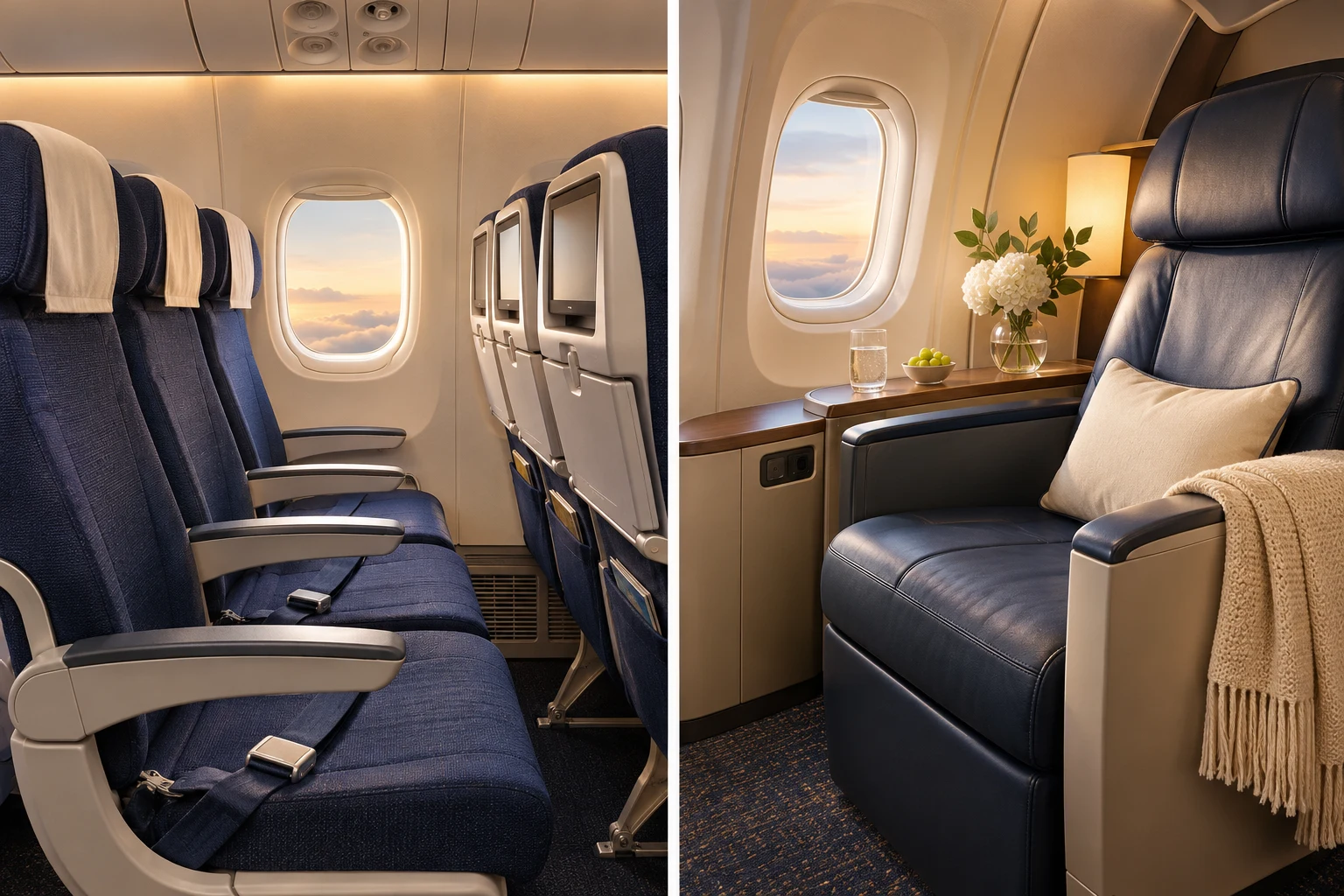
Read the cabin beside every flight
Mixed-cabin flights combine different cabin classes within an itinerary. You might fly economy to a hub and business class on the long-haul sector, or discover that only a short connection has the premium seat. The practical value depends on where you spend the hours.
Open the flight details before paying. Record the cabin for each segment in both directions and identify any lower-cabin warnings. A large “Business” heading can be less informative than the small cabin label beside the overnight flight.
Check the longest leg first.
Why mixed-cabin itineraries appear
Cathay Pacific's mixed-cabin explanation describes lower-cabin travel on some shorter connecting legs when the desired cabin is absent from the aircraft, seats are unavailable or an airline agreement limits availability.
A mixed itinerary can therefore reflect the aircraft and available inventory, even when you searched for a higher cabin. It can also be a deliberate choice if you prefer to spend more on one part of the trip.
The useful question is whether the combination suits you. Economy for a short daytime connection followed by business on an overnight journey may be attractive. The reverse combination may deliver little of the comfort you hoped to buy.
Build a segment-by-segment comparison
Write one row per flight. Include its duration, operating airline and cabin. Add the departure time if sleep or working onboard is the reason for considering an upgrade.
| Illustrative itinerary | Short connection | Long flight | Likely priority |
|---|---|---|---|
| Option A | One hour in economy | Ten hours in business | Long-flight comfort |
| Option B | One hour in business | Ten hours in economy | Check whether the premium adds enough value |
| Option C | One hour in economy | Ten hours in premium economy | Compare a smaller cabin upgrade |
These are invented combinations, not current offers. They show why counting premium segments can mislead. One premium segment may represent most of the trip or barely the first hour.
Check the return separately. You may be happy to fly economy on a daytime return while paying for more space overnight in the other direction. Make sure the booking actually reflects that choice.
A cabin name does not specify the seat
After identifying the cabin, inspect the product on the selected aircraft. Business class can involve different seat designs across routes and fleets. Premium economy also varies, and extra legroom within economy is a separate purchase.
Use the airline's flight-specific information and seat map where available. Look at the layout, seat position and features that matter to you. An airline's promotional photograph may show a product used elsewhere in its network.
Our guide to reading aircraft seating layouts helps turn the diagram into a practical comparison. Equipment can change, so keep expectations tied to the confirmed booking and the airline's conditions.
If you need a particular seating arrangement for an accessibility reason, ask the airline directly before purchase. A cabin label is not enough detail to resolve an individual requirement.
Separate cabin class from fare conditions
Mixed cabins describe where you sit. The fare rules determine matters such as changes and cancellation. A business segment does not automatically make the entire ticket refundable or freely changeable.
Read the rules applicable to the itinerary and ask how they interact if only one flight needs changing. Check any fee, fare difference and deadline. Avoid assuming the more generous-looking segment sets the conditions for all the others.
Our guide to booking classes and fare restrictions explains the difference between cabin, fare brand and reservation category. Keeping those labels separate makes it easier to compare quotes from different sellers.
For reward travel, check the program's rules and cash charges as well as cabin availability. A mixed-cabin award can require careful evaluation of the premium you are paying in points.
Verify the ticketed baggage allowance
Look at the allowance recorded for your actual journey. Do not automatically apply the highest cabin's advertised baggage limit to every flight, particularly where partner airlines or separate tickets are involved.
Emirates' checked-baggage guidance shows that allowances can use weight or piece systems and depend on the route and fare. Its baggage FAQs also direct passengers to check rules when other airlines operate parts of the trip.
Cabin baggage needs its own check against each operating carrier's limits. A larger cabin-bag allowance on the premium segment may not help you board the economy feeder flight with the same bags.
Keep the ticketed allowance and any purchased extras with the confirmation. If an amendment changes the operating airline, review the baggage details again before packing.
Check lounge and priority benefits individually
Ask whether lounge access applies at your origin, connection point or both. Eligibility can depend on the departing flight, ticket conditions, status and the specific lounge. A premium segment somewhere in the itinerary does not answer every access question.
Do the same for priority check-in, boarding and any other service that matters to you. Confirm whether it is included at the airport where you intend to use it.
Assign value only to benefits you can realistically use. A lounge at an airport where you have a very short connection may be less useful than a comfortable seat on the long flight. Conversely, a longer layover may make a confirmed lounge benefit more attractive.
Check guest and child rules if traveling together. Paying for one person's premium cabin can create different airport entitlements within a family.
Compare the extra price with the useful comfort
Consider an invented return trip costing £850 entirely in economy. A mixed-cabin option costs £1,250, placing the ten-hour overnight outward flight in premium economy while the remaining flights stay in economy. The additional cost is £400.
Divide that extra by the ten upgraded hours and you get £40 per hour of premium seating. This is a comparison tool, not a valuation rule. You may care more about arriving rested than the hourly figure, and the seat itself still needs checking.
Now consider another £1,250 option that upgrades only two one-hour connections. Its additional £400 buys a different experience. Matching total prices cannot make those two offers equivalent.
Our guide to deciding whether premium economy is worthwhile develops the comfort question. Compare the real product with what you need from the journey.
Search for alternatives without losing the whole picture
Try nearby dates if your schedule allows, since a different departure may have the desired cabin available on the important segment. Check another connection point or an alternative flight on the same route.
Compare a nonstop economy option too. A premium long-haul segment with an exhausting connection can be less appealing than a shorter total journey. Include the layover and arrival time in the decision.
Our guide to weighing connecting flights against their savings helps with that wider comparison. The most comfortable individual seat does not necessarily produce the easiest door-to-door trip.
If you consider splitting the itinerary into separate tickets to control the cabins, price the added responsibility and baggage costs. Keep the ticket structure visible alongside the cabin plan.
Save exactly what was offered
Before payment, save the flight-by-flight summary showing the cabin on each segment. Check that the final confirmation matches it. If something differs, contact the seller promptly and identify the affected flight.
After a schedule change or rebooking, inspect the cabins again. A revised itinerary may preserve the destination while changing the seating product or cabin on a particular flight.
A mixed-cabin arrangement disclosed before purchase is different from an involuntary downgrade after booking. If the latter happens, ask the airline about the applicable options and rights for that journey. Keep the original confirmation and the revised details.
Do not rely on an airport upgrade to repair a combination you dislike. Availability and price can change. Buy an itinerary you are prepared to use as confirmed.
Compare the experience for everyone traveling
A mixed-cabin offer deserves another look when traveling as a couple or family. Check that the quoted cabin applies to every passenger on every segment. Search results for one traveler may differ from the availability offered when several people are booked together.
If your group deliberately chooses different cabins, discuss the practical arrangements before purchasing. Seating together, helping with a child or sharing essential items becomes harder when passengers are assigned to different sections. Ask the airline about any relevant restrictions instead of assuming movement between cabins will be permitted.
Put medication, documents and anything needed during the flight with the person who needs it. A companion's bag is an inconvenient storage solution when that companion is elsewhere on the aircraft.
Decide what the upgrade needs to accomplish
Write down the main reason for paying extra. A traveler hoping to sleep before a morning meeting may value the overnight segment most. Someone seeking more comfortable daytime seating may prioritize the longest waking stretch. Those priorities can produce different choices from the same search results.
Compare the departure and arrival times alongside the cabin map. A premium seat on an inconvenient schedule may give you less useful rest than a cheaper flight timed around your routine. Include the trip to the departure airport and the journey after landing when making that judgment.
Keep the comparison simple: which segment receives the upgrade, what feature matters to you and how much extra the complete journey costs. This makes it easier to reject a prominent premium label when the included improvement falls on a flight where you place little value on it.
Record those priorities before comparing more offers.
Your questions answered
Does a business-class search guarantee business on every flight?
No. Read the cabin label on each segment and any mixed-cabin warning before payment. Check both directions, especially the longest or overnight flight.
Can a mixed-cabin ticket be good value?
Yes, if the higher cabin covers the part of the journey where you value it and the extra price is reasonable for you. Compare the complete itinerary and actual seat product.
Will I automatically get the highest cabin's baggage allowance throughout?
Check the allowance recorded on your ticket and the rules for any partner-operated flights. Cabin baggage and checked baggage can require separate checks.
Is a mixed-cabin booking the same as a downgrade?
A disclosed mixed-cabin purchase contains different cabins from the outset. An involuntary change to a lower cabin after booking is a separate issue to raise with the airline.
Should I book a poor combination and hope to upgrade later?
Only buy it if you are willing to travel in the confirmed cabins. A later upgrade may be unavailable or cost more than you expect.