
Seats & Onboard Comfort | 11 minute read
Aircraft Seat Configurations: Choosing a Layout That Suits Your Trip
Read aircraft seating layouts with confidence, then compare the seats you can actually book for your party and budget.
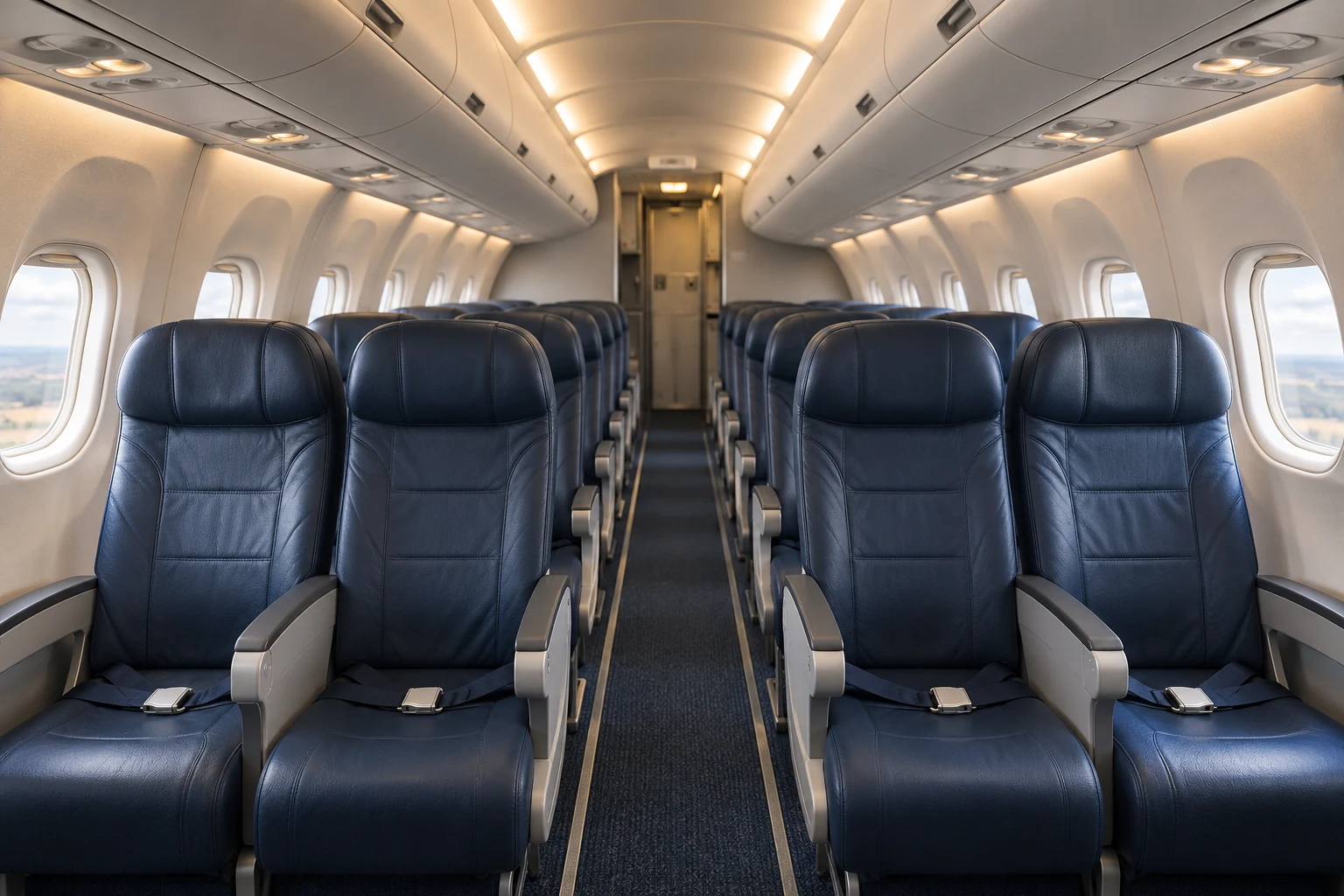
Start with the arrangement, then check the seat
An aircraft seat configuration describes how seats are arranged across the cabin and along its length. A 3-3 layout has two blocks of three seats separated by one aisle. A 2-4-2 layout has a pair beside each window and four seats in the middle, with two aisles between the blocks.
The layout helps you find a pair for a couple, a row for a family or an aisle for a solo traveler. It does not tell you everything about comfort. Seat width, distance between rows, armrests and the position of cabin facilities still matter.
Use the operating airline's map for your flight, date and cabin. Then check whether the seats that suit you are available and what selecting them adds to the fare. The best-looking layout is little help when its last available seat is precisely the one you hoped to avoid.
What the numbers on a seat layout mean
Read the numbers from one side of the aircraft to the other. Each number is a block of seats and each hyphen represents an aisle. Add the numbers to find how many passengers sit across a complete row, excluding gaps or unusual rows.
| Layout | Seats across | What to notice |
|---|---|---|
| 2-2 | Four | Every seat is a window or aisle position |
| 3-3 | Six | Each block has a middle seat |
| 2-4-2 | Eight | Window pairs flank a central block of four |
| 3-3-3 | Nine | Three blocks each contain three seats |
| 3-4-3 | Ten | The central block contains two inner seats |
A 2-4-2 arrangement can appeal to couples because the outside pair contains no third passenger. For a group of three, a block of three may fit better. Neither preference establishes that one cabin is universally more comfortable.
The same notation can describe very different seats in different cabins. Four seats across in a small aircraft do not imply the space or service of four premium seats across a much wider aircraft. Keep cabin class attached to every comparison.
Find the map that matches your booking
Look first at the flight details for the operating carrier and aircraft type. The airline selling the ticket may use a partner to operate part of the journey, so the brand at the top of the search results is not enough. Our guide to understanding codeshare flights explains that distinction.
Next, open the operator's seat map and identify the cabin version. Airlines can have several layouts for an aircraft family. Compare the total seat count, premium cabin size and row numbering with the map in your booking.
Air New Zealand's aircraft seat maps, for example, provide separate aircraft configurations and seat information. That is the level of detail you want, rather than a generic picture of the aircraft model.
Manufacturer examples can help explain a layout, but they do not replace your airline's map. Airbus describes a typical A330 economy cabin with a 2-4-2 arrangement. The word typical matters: use the actual operator and version to establish what your flight offers.
If the booking screen and fleet page disagree, ask the airline which configuration is currently planned. Keep the answer with your booking details and remember that the assigned aircraft can change.
Choosing a layout when you travel alone
For a solo traveler, direct access to the aisle may matter more than the number of seats across the entire cabin. Count how many people would need to move when you get up, and how many might need to pass you.
In an outside block of three, the aisle passenger can be interrupted by two people. In an outside pair, only one companion is between the aisle and window. In a central block, the route out depends on which seat you choose and the passengers on either side.
A window seat can give you a side of the cabin to lean toward and a view when the window aligns with the row. It also leaves you dependent on others moving when you need the aisle. Your preference may change between a daytime flight and an overnight departure.
Think about how you actually fly. If you stand regularly, choose convenient access. If you tend to settle in and sleep, a window might be worth the tradeoff. The aisle-versus-window comparison looks at those practical differences.
Pairs, middle blocks and traveling together
A pair beside the window is an easy starting point for two people who want to sit together without a stranger in the same block. Check that both seats remain available before paying for either one.
Two aisle seats across from each other can suit companions who both want easy access. You can talk across the aisle when appropriate, but you are not side by side in the same way. Trolleys, crew and passengers will pass between you.
In a central block of four, choosing the two inner seats puts you together but leaves each of you needing someone to move to reach an aisle. Taking an aisle and its neighboring inner seat gives one of you easier access.
Avoid building your plan around booking a window and aisle in a three-seat block and hoping the middle stays empty. An unselected seat on a map is not a promise of an empty seat on departure. Choose positions you would accept if every seat fills.
Match the layout to the people who need help
A family of three may find one three-seat block simpler than a pair with the third person across the aisle. A family of four could prefer a central block of four, two pairs or two seats directly behind two others. The right answer depends on children's ages and who needs supervision.
Decide where the adults should sit before selecting individual seat numbers. Think about helping with food, reaching a bag and accompanying a child to the toilet. A diagram that looks beautifully symmetrical may be less useful once you place the people in it.
For infants, confirm the carrier's approved seating arrangements and any restrictions associated with a bassinet or child restraint. Do not assume that an empty-looking front row is available to every family or that adjacent seats guarantee a bassinet.
Review the airline's family seating arrangements before paying separately for each person. Where seating together is included or assistance is available, understand exactly what that means for your booking rather than buying an unnecessary duplicate service.
Look closely at the unusual rows
The headline layout describes the main cabin pattern. Near the rear, a narrowing fuselage can create different blocks. Around doors, galleys or partitions, a row might have missing seats or an unusual gap.
Those exceptions deserve a closer look. A pair near the back can be appealing, but the adjacent toilet or galley might matter more to you than losing a middle seat. A seat beside a large gap may have storage or armrest arrangements that differ from the surrounding rows.
Check the legend for restricted recline, missing windows and fixed armrests. Then read the seat-specific notes. Icons often carry details that a simple seat rectangle cannot convey.
For a front-of-section row, our explanation of bulkhead seat tradeoffs helps you assess the partition, storage and fittings. Do not treat every open patch on the drawing as usable room for your feet.
Compare width and legroom separately
A cabin with fewer seats across may look more spacious, but aircraft widths differ. You cannot reliably compare a four-across regional cabin with an eight-across long-haul cabin by counting seats alone.
Find the stated seat width and pitch for the exact configuration. Width concerns side-to-side space. Pitch measures the distance between matching points on successive rows, so it is a guide to row spacing rather than a direct measurement of empty knee room.
Then check whether your chosen position has equipment under the seat ahead or a tray stored in the armrest. A useful comparison combines the dimensions with the seat's actual fittings.
If the airline gives a range of measurements, ask which figure applies to the row you can book. A range for the cabin is not confirmation that every available seat has the largest spacing listed.
Put a price on the layout you want
Compare the total for the people traveling together, including seat selection on every flight. A convenient pair is not automatically worth a large fare difference, but a modest fee can be sensible if the arrangement solves a specific problem.
Here is an invented example. Two tickets on Flight A cost $800 together, and selecting the available window pair adds $35 per person. The total is $870. Flight B costs $840 for two tickets with suitable adjacent seats included. Flight B is $30 cheaper once you compare what you actually intend to buy.
Now imagine Flight B requires a connection while Flight A is nonstop. The $30 difference no longer describes the whole decision. Add journey time and the practicalities of the connection before deciding whether the seating arrangement deserves priority.
Pay for a benefit you can name: an outside pair, a convenient aisle or a workable family grouping. Paying simply because a map uses a more attractive color is a less convincing travel strategy.
Recheck the layout after a flight change
After a schedule or aircraft change, open the seat map again. The same seat number can describe a different position in another configuration. Confirm the window or aisle status, cabin and neighboring seats rather than relying on the number alone.
If you paid for a particular seat category and the replacement does not provide it, contact the airline or booking agent. Keep the seat receipt and ask which reassignment or refund options apply to that purchase.
For a group, check every passenger together. One person retaining their seat does not establish that everyone else still sits nearby. It is easier to discuss alternatives before boarding than after the cabin is full.
Your questions answered
What does a 3-3 aircraft seat configuration mean?
It means three seats on one side of a single aisle and three on the other. Each full row has six seats, including one middle seat in each block.
Is a 2-4-2 layout better for couples?
The outside pairs can be convenient because you sit together without a third passenger in the same block. Check their availability, selection fees and seat features before treating the layout as the deciding factor.
Does fewer seats across mean wider seats?
Not necessarily. Aircraft have different cabin widths. Compare the stated seat width for the exact airline, aircraft configuration and cabin class rather than using the number of seats alone.
Can an aircraft seat configuration change after booking?
Yes, the planned aircraft or cabin version can change. Recheck your assigned seats after notifications and at check-in, particularly if your party needs a specific arrangement.
Should I choose an aircraft before choosing a flight?
Use the aircraft layout as one part of the decision. First make sure the route, timing and total price work, then compare the seats available on the realistic options.