
Baggage & Sports Equipment | 11 minute read
Qatar Airways Baggage Allowance: What to Compare Before Booking
Qatar Airways baggage depends on route, fare and cabin. Check whether your booking uses a weight or piece allowance before comparing fares or buying extra baggage.
How much baggage does Qatar Airways include?
Check the allowance shown on your Qatar Airways booking rather than relying on one airline-wide number. Your route and fare determine whether the limit is expressed as a total weight or as a number of bags with a maximum weight each.
Keep cabin baggage separate from checked baggage. A generous hold allowance does not give you permission to carry a heavier bag into the cabin.
Before comparing tickets, write down what you intend to pack. Then price the fare that meets those needs, including any additional baggage purchase. The cheapest suitable ticket can be different from the lowest fare displayed first.
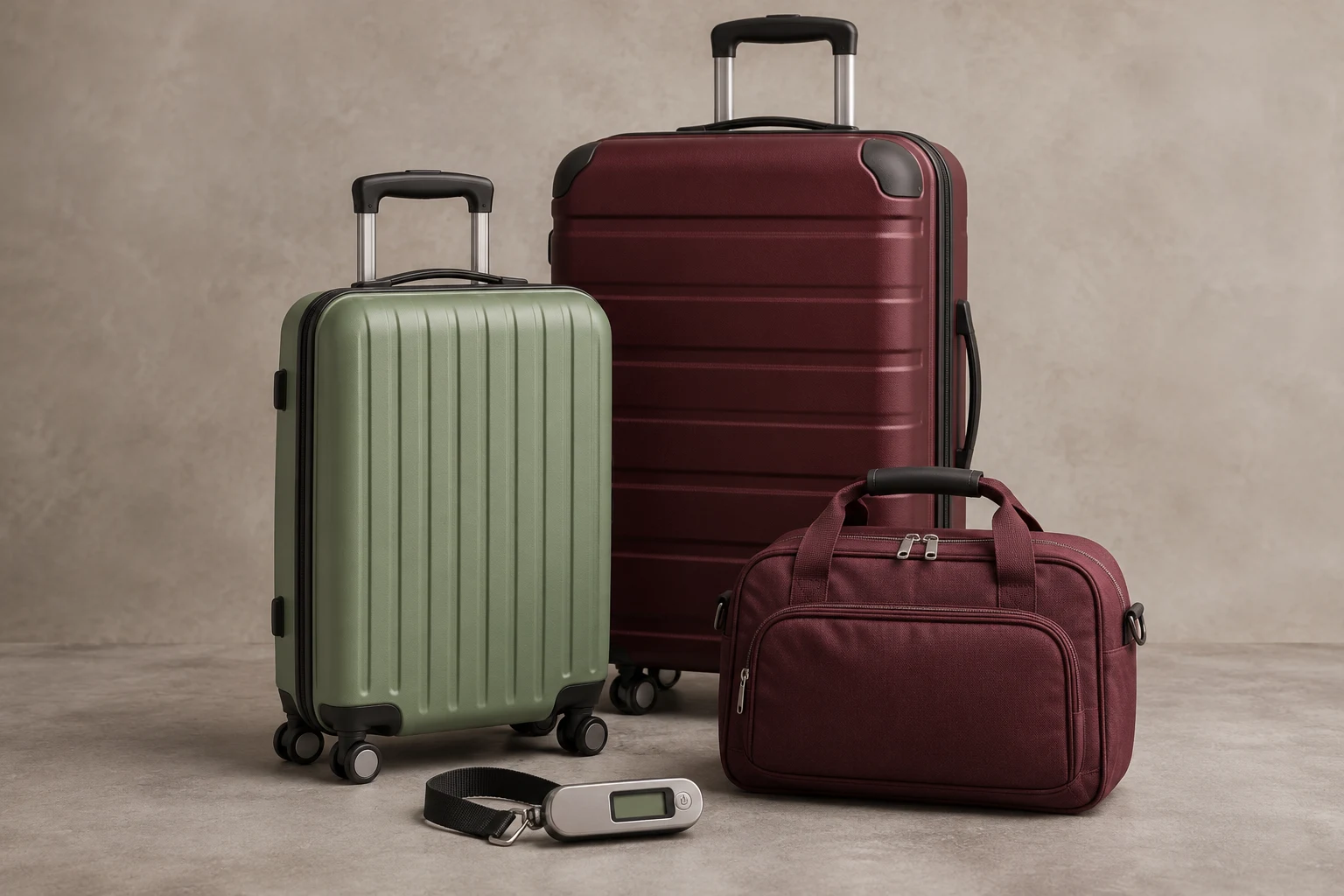
A luggage scale is usually more helpful at home than a hopeful expression at check-in.
The published economy allowance at a glance
Qatar's official baggage allowance page gives these general economy checked limits, with route exceptions to confirm in your booking.
| Fare | Other destinations | Africa or Americas |
|---|---|---|
| Lite | 20kg total | One bag up to 23kg |
| Classic | 25kg total | Two bags up to 23kg each |
| Convenience | 30kg total | Two bags up to 23kg each |
| Comfort | 35kg total | Two bags up to 23kg each |
The general economy cabin allowance is one bag up to 7kg, with a 10kg Brazil exception. Maximum cabin dimensions are 50 by 37 by 25cm. Checked dimensions are generally 158cm combined for Africa and Americas routes, or 300cm elsewhere. No checked piece may exceed 32kg. Confirm partner-flight and route-specific rules.
Use the table to understand the structure, then use your ticket to establish the allowance you can actually rely on. It is especially important to inspect the itinerary when the journey includes another airline.
Weight allowance and piece allowance mean different things
Under a weight system, the comparison begins with the combined weight of your checked bags. Under a piece system, both the number of bags and the limit for each bag matter.
Consider a simple illustrative calculation. If a booking permits two bags up to 23kg each, packing one at 28kg and another at 18kg does not make each bag compliant merely because the total is 46kg.
The distribution matters.
By contrast, a total-weight allowance requires you to add the weights of the bags you intend to check, while still respecting applicable limits for individual items. Do not treat a large total allowance as permission to pack one oversized or excessively heavy case.
Write the allowance in full rather than abbreviating it to a single number. Recording two bags with a per-bag maximum is clearer than writing only the combined theoretical weight.
That habit also helps when comparing airlines. A weight allowance and a piece allowance may suit different packing plans even when their headline numbers appear similar.
Where to check your own allowance
Open the booking confirmation and the airline's booking-management page. Find the baggage entry for the actual itinerary and each traveler.
Record the fare name, cabin and allowance together. If you later compare a different fare, you will know which benefits changed rather than assuming the route alone determines everything.
Check the outbound and return. If you bought separate tickets or changed one direction, do not assume the same allowance applies throughout.
If the display is unclear, ask the airline or ticket seller to confirm the allowance before paying for extra baggage. Provide the route, flight details and fare information so the answer relates to your booking.
Save the confirmation of any purchase. A receipt showing the passenger and relevant flights is more useful than a general screenshot of a baggage advertisement.
Choose a fare using your real packing needs
Make a rough packing list before purchasing the ticket. Count the suitcases you expect to check and estimate their packed weight using the bags you own.
Include the return journey. Gifts, shopping or equipment can make it different from the outbound flight. Plan for that difference instead of discovering it while checking out of the hotel.
Compare the lower fare plus the extra baggage you need with the next suitable fare. Also identify any other benefits you would actually use, such as seat selection or more useful ticket conditions.
Do not count every inclusion as a saving. If you would not buy a service separately, it does not reduce your actual spending.
Our guide to comparing flights with baggage included explains how to avoid letting the starting fare dominate the decision.
For a group, calculate needs per traveler. Confirm any permitted sharing instead of assuming the combined party allowance overrides individual restrictions.
Buying additional Qatar Airways baggage
Use Qatar's extra baggage information and the quote available for your booking. The applicable charge depends on the journey and purchase conditions, so a fee from another route may be irrelevant.
Check what the purchase covers. Identify the passenger, flights, direction and amount of extra allowance. Do not assume an outbound purchase also covers the return.
Read any purchase deadline and conditions before relying on an online option. If your trip includes a partner, confirm that the product can be used on the relevant flights.
Keep the receipt with your travel documents and check that the allowance appears correctly in the booking. Resolve discrepancies before departure where possible.
Our guide to deciding when to add baggage helps you plan the purchase after your packing needs are clear, without leaving everything to the airport.
A fare comparison using invented prices
Suppose a lower fare costs £620 and a higher fare meeting your baggage needs costs £680. These figures are invented and are not current Qatar Airways prices.
If the extra baggage quote for the lower fare is £85, the lower ticket becomes £705 for your requirements. The higher fare is £25 cheaper under those assumptions.
If you can comfortably pack within the lower fare's allowance, its total remains £620. The higher fare then costs £60 more, and you should decide whether its other useful benefits justify that amount.
Repeat the calculation for both directions and all travelers. Distinguish an allowance purchased for one passenger from a shared ground expense such as a taxi.
The purpose is to find the cheapest suitable booking, not to make the larger allowance win every comparison. Packing less can be a valid saving when it does not undermine the trip.
Plan cabin baggage independently
Start with the items you need during the flight and immediately after arrival. Choose a bag that fits the applicable dimensions and weigh it after adding electronics and other dense items.
Check how the airline classifies any additional personal item. Do not assume that a laptop bag automatically sits outside every cabin-baggage limit.
Our guide to distinguishing personal items from cabin bags explains why the categories matter.
Keep restricted-item rules separate from allowance. An item can fit inside the permitted bag and still be subject to packing restrictions or approval requirements.
For batteries, liquids, medical equipment or unusual items, consult the airline's current specific guidance before packing. Avoid transferring items between cabin and hold merely to solve a weight problem without checking whether that transfer is permitted.
Connections and partner flights need another check
Look at the operating airline on every sector. A Qatar flight number or a booking sold by Qatar does not by itself explain every baggage rule on a partner-operated flight.
Use the allowance stated for the itinerary and ask for clarification if the booking displays conflicting information. Do not simply choose whichever airline's public table is more generous.
Confirm the baggage collection process for the connection. Whether you must collect a bag is a separate question from how much baggage you may take.
Our guide to checking baggage collection on connecting flights explains the details to establish before traveling.
If you have separately booked onward flights, check each ticket's allowance. A suitcase acceptable on the first journey may require another purchase on the next.
Special equipment and family baggage
Ordinary suitcase allowances do not answer every question about sports equipment, musical instruments or bulky items. Check the relevant policy for the item you intend to carry and whether advance arrangements are required.
Measure the item in its travel case. Protective packaging can make a significant difference to both dimensions and weight.
For infants and children, read the allowance attached to the passenger's ticket and the rules for strollers or car seats. Do not assume an adult allowance applies unchanged.
If assistance equipment is involved, discuss the arrangements directly with the airline. Keep the confirmed handling instructions with the booking so the airport process is clear.
Allow time to resolve unusual baggage questions before departure. A standard extra-baggage purchase may not address an item's size, handling or approval requirements.
A practical check before leaving home
Pack the bags you will actually take, then weigh each one separately. Record the result so you can see whether the problem is the total allowance, an individual bag or the number of pieces.
Measure bulky bags with their handles, wheels and any expanded sections as required by the airline. Soft-sided luggage can become larger once filled.
Leave a practical margin for small additions and differences between scales. Packing exactly to the displayed limit gives you little room for a last-minute item.
Check labels and contact details, then keep the relevant booking and baggage receipts accessible. Know which bags you intend to check and which will remain with you.
For the return, repeat the weighing after shopping or moving items between cases. The outbound measurement does not describe a differently packed bag.
Measure the packed bag rather than its label
A suitcase label may describe the body of the case or use a broad marketing category. Measure the bag you intend to check in the form you will actually travel with.
Close the bag fully and include any expanded section. Check how the airline defines the dimensions to be measured, including projecting parts where applicable.
For a combined-dimensions rule, add the measured length, width and height. Do not compare only the longest side with a figure that represents all three added together.
Use a separate note for each bag. Record its dimensions beside its packed weight so you can identify which requirement needs attention without repacking everything unnecessarily.
If a case is too large, removing clothes may reduce weight without solving the size problem. A different bag may be the practical answer. If it is simply too heavy, review the contents and the allowance before buying replacement luggage.
Consider the empty weight when choosing a case. Heavy protective luggage may be appropriate for some contents, but it uses part of the allowance before you add anything.
For an unusual shape, contact the airline with the actual measurements and a clear description. Avoid assuming that an ordinary suitcase purchase or additional weight payment covers every item.
Checking this at home gives you time to choose a sensible solution instead of making a rushed decision beside the airport scales.
If you replace a suitcase, repeat the measurement after packing it. Different shapes can change how belongings fit, and expanding a new case can alter its dimensions. Check the finished bag rather than assuming a smaller-looking replacement automatically resolves every requirement without checking.
Your questions answered
Does Qatar Airways have one baggage allowance for every economy ticket?
No. Read the route and fare details in your booking. The allowance can be expressed as total weight or as a number of pieces, and those formats require different packing calculations.
Can I combine two bag limits into one heavy suitcase?
Do not treat a per-piece allowance as one combined limit. Each bag must satisfy the applicable conditions. Check the individual maximum as well as the total or number of pieces.
Should I buy a higher fare for more baggage?
Compare it with the lower fare plus the additional allowance you need. Count other benefits only when you will use them. The right answer depends on the quoted prices and your packing plan.
Does extra baggage automatically cover my return flight?
Check the purchase details. Confirm the passenger and flights covered, then keep the receipt. Do not assume a purchase for one direction applies to every flight in the booking.
What if my connection uses another airline?
Use the itinerary's stated allowance and confirm any unclear partner rules. Also check whether you must collect baggage during the connection, because that is a separate part of the transfer process.